
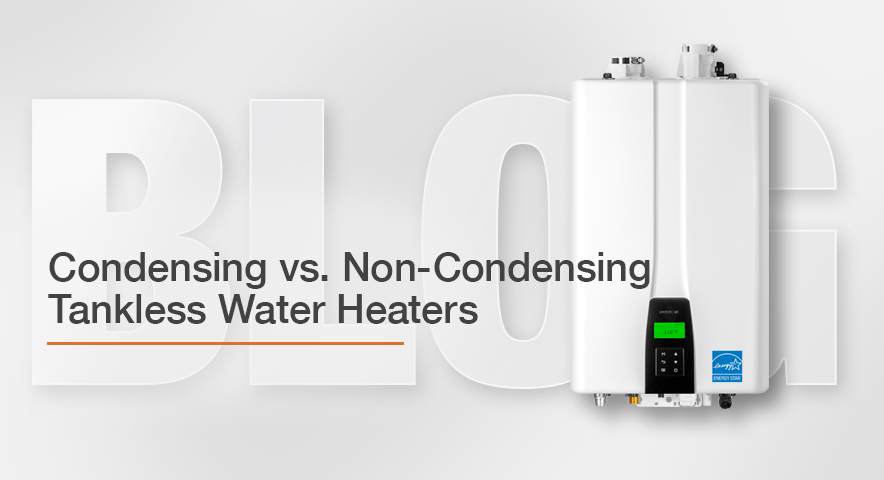
Condensing and non-condensing tankless water heaters both supply endless hot water as needed, but the way they heat water and vent the exhaust gas is a little different.
Key Takeaways
- Efficiency: Condensing models use dual heat exchangers to capture residual heat for maximum efficiency (up to 0.96 UEF), while non-condensing models have a single heat exchanger design.
- Venting: Condensing units can use PVC, CPVC, or polypropylene venting, offering flexible installation options.
- Drainage: Condensing units will require a dedicated drain line.
Heat exchangers: condensing versus non-condensing
The main difference is how they capture and use heat energy. Typically, condensing tankless water heaters have two heat exchangers, and non-condensing models only have one.
Condensing technology (maximum energy efficiency): After the gas burner heats the water in the primary heat exchanger, the exhaust gas (which is still hot) is routed through a second stainless steel heat exchanger. This secondary stage captures residual heat from the exhaust and uses it to pre-heat incoming cold water, maximizing every BTU of energy used.
Non-condensing technology (direct heat transfer): With a streamlined, single heat exchanger design, non-condensing models focus on rapid, direct heat transfer to supply hot water. This established technology is designed for simplicity and durability, venting the exhaust gas immediately after the heating process is complete.
This means condensing tankless water heaters are more energy efficient, and have cooler exhaust gas to vent.
Venting compatibility & installation materials
Because the exhaust temperatures differ between condensing and non-condensing tankless water heaters, they use different venting materials. This is an important factor when planning your installation.
- Condensing models (venting flexibility): Because the secondary heat exchanger cools the exhaust gas significantly, condensing units can use a wider variety of venting materials, including PVC, CPVC, and polypropylene. This allows for flexible venting runs, making them adaptable to various home layouts.
- Non-condensing models (high-heat venting): These units produce hotter exhaust gas and are designed to vent through metal, CAT.III venting. This is the industry standard for traditional non-condensing tankless installations.
Advantages of non-condensing tankless water heaters
- Lower cost than condensing models
- Smaller size and lighter weight than condensing models (because they only have one heat exchanger)
- Minimal ongoing maintenance (compared to annual maintenance for condensing models)
Learn more about non-condensing tankless water heaters.
Advantages of condensing tankless water heaters
- Higher energy efficiency than non-condensing models (UEF up to .96 compared to .80)
- Higher flow rates
- You can use PVC or PP for venting, which allows for longer venting runs and more versatile installation paths
Learn more about condensing tankless water heaters.
Should you get a condensing or non-condensing tankless water heater?
Both systems deliver the luxury of endless hot water, but your specific project requirements will determine the ideal fit.
Consider a condensing model if:
- You’re building a new home or addition: The ability to use flexible PVC venting makes running new vents easier and more adaptable to new floor plans.
- You prioritize eco-friendliness: If getting the highest possible UEF rating is your main goal, condensing technology is your best choice.
Consider a non-condensing model if:
- You’re replacing an existing tankless unit: If your home already has an existing non-condensing tankless water heater.
- Drainage is difficult to access: If the installation location (such as an attic or interior wall) makes it hard to install a condensate drain line.
It can also be helpful to talk through your options with a certified Navien installer before choosing between a condensing and non-condensing tankless water heater.
Frequently Asked Questions
Can I replace a non-condensing water heater with a condensing model?
Yes! Upgrading to a condensing model is a popular choice for increasing energy efficiency. Since condensing units create liquid condensate as part of the energy-capturing process, the primary addition to your installation will be a condensate drain line. Your installer will plan a route for this line to a nearby floor drain or pump to ensure the new system operates correctly.
What is a condensate neutralizer?
A condensate neutralizer kit is used with condensing tankless water heaters. It neutralizes the water produced during the condensing process to ensure it has a safe, neutral pH level before it flows into your home’s drainage system. This protects your plumbing pipes and is easily replaced during routine maintenance.
Do condensing tankless water heaters qualify for tax credits?
Often, yes. Because condensing models achieve premium Uniform Energy Factor (UEF) ratings (up to 0.96), they frequently meet the criteria for federal tax credits and local utility rebates designed to reward high-efficiency home upgrades.
Learn More:

Pictured: NPE-A2 Series condensing tankless water heater (left) and NHW-AI Series non-condensing tankless water heater (right).


