
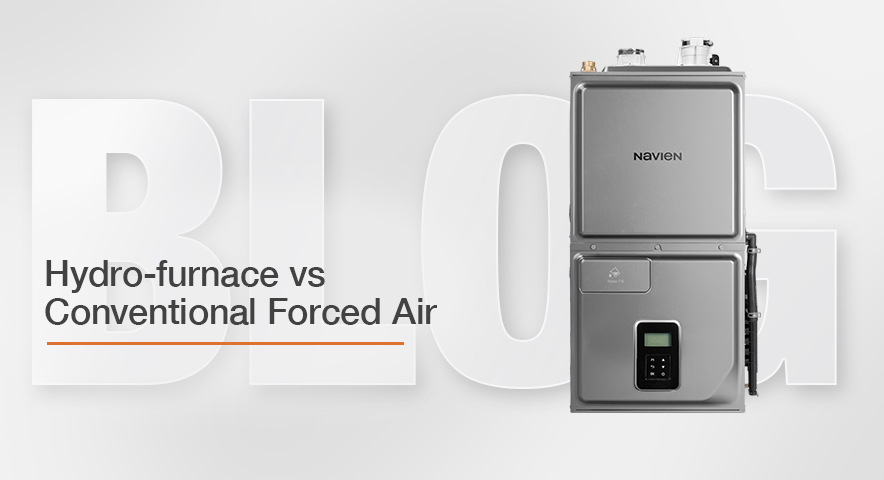
Both conventional gas furnaces and hydronic furnaces heat a home through the same basic forced-air setup: a blower moves warm air through ductwork and supply registers. The main difference is how the furnace creates and transfers heat into that airstream.
A conventional forced-air gas furnace burns gas and transfers combustion heat through a heat exchanger directly to the air moving through the furnace. A hydro-furnace burns gas to heat water first, then circulates the heated water through a hydronic heat exchanger that warms the air.
Neither approach is automatically right for every home. Finding the right fit depends on your comfort preferences, installation requirements, and efficiency goals.
Hydro-furnace vs. conventional gas furnace at a glance
| Item | Traditional gas furnace | Hydro-furnace |
| How heat is made | Gas burner heats a combustion heat exchanger. | Gas burner heats water in a sealed combustion heat exchanger. |
| How air is heated | Blower moves return air across the furnace heat exchanger. | Heated water circulates through a hydronic heat exchanger, then the blower moves air across that coil. |
| Heat delivery | Forced air through ductwork. | Forced air through ductwork. |
| Heating stages | Varies by furnace: single-stage, 2-stage or variable-capacity designs are available. Navien’s NDF gas furnace uses 2-stage operation. | Variable capacity: 15% to 100% |
| Heating comfort | Depends on staging and blower controls. 2-stage and variable-speed designs can reduce temperature swings compared with basic single-stage equipment. | Ability to automatically adjust heat and airflow in increments as small as 1%. Navien's NPF Hydro-furnace provides even temperatures and consistent comfort, eliminating the on/off control of traditional staged furnaces |
| Sound | Depends on firing rate, blower speed, cabinet design, and installation. | Separating combustion from the conditioned airstream can reduce combustion-related sound. Lower-capacity operation can also reduce airflow noise. |
| Efficiency | Measured by AFUE; high-efficiency condensing gas furnaces can reach the mid-90% range and above. Navien’s NDF gas furnace has an AFUE of 96%. | Measured by AFUE; hydronic furnace efficiency depends on the specific model. Navien’s NPF Hydro-furnace has an AFUE of 97%. |
| Installation | Multiple installation orientations available. Requirements vary by model and home. | Multiple installation orientations available. Requirements vary by model and home. |
How a conventional gas furnace works
In a conventional forced-air furnace, the gas burner heats a combustion heat exchanger inside the furnace cabinet. The blower pulls return air into the furnace, moves it across the hot heat exchanger and sends the warmed air back through the home’s ductwork.
Modern gas furnaces are not all the same. A basic single-stage furnace operates at one heating output. A 2-stage furnace can run at low or high fire, while some furnaces use variable-capacity or modulating heat. Blower design matters too: a variable-speed ECM blower can adjust airflow precisely instead of operating at one fixed speed.
How a hydronic forced-air furnace works
A hydronic forced-air furnace still uses gas and still heats the home through ductwork. The difference is inside the furnace. Combustion heats water in a sealed heat exchanger outside the conditioned airstream. A pump then circulates that hot water through a second, hydronic heat exchanger, where heat transfers into the air moved by the blower.
That design keeps the combustion heat exchanger separate from the conditioned air and because the air is not exposed to the extreme temperatures that it would see in a conventional furnace design, the air leaves the furnace much softer and less dried out than a traditional gas furnace. This provides greater comfort while reducing the need for a humidifier. Couple that with Navien’s NPF design ability to adjust from 15% to 100% of capacity to precisely meet home comfort needs and you have a superior home heating comfort solution.
The biggest differences homeowners are likely to notice
1. Staging and temperature control
Furnace type alone doesn’t determine how many heating stages you get. Conventional gas furnaces may be single-stage, 2-stage or variable-capacity.
For Navien’s current lineup, the comparison is straightforward: the NDF conventional gas furnace uses 2-stage heating, while the NPF Hydro-furnace varies its capacity from 15% to 100% capacity. Two-stage operation gives the furnace a lower-output option during milder conditions. Variable-capacity range allows smaller adjustments as the heating load changes.
2. Comfort and indoor humidity
Traditional vs hydronic furnace designs expose the heated airstream to different temperatures. A conventional furnace moves air across a combustion heat exchanger. A hydronic furnace moves air across a hot-water coil, where the heat-transfer temperature is lower.
That can make hydronic forced-air heat feel gentler and have less impact on conditioned-air humidity. The actual comfort of either system still depends on equipment sizing, airflow, ductwork, thermostat settings and how the furnace is controlled.
3. Operating sound
Noise is also determined by more than furnace type. Blower speed, firing rate, duct design and installation all matter. A 2-stage conventional furnace can run more quietly at low fire than a basic single-stage furnace. A hydronic design can further isolate combustion noise because the combustion heat exchanger is outside the conditioned airstream.
4. Energy efficiency
AFUE is the most useful number for comparing gas furnace fuel efficiency. It represents the percentage of fuel energy converted into usable heat over a heating season. Both conventional and hydronic furnaces can use high-efficiency condensing technology, so hydronic doesn’t automatically mean a higher AFUE rating.
It’s best to compare specific models you’re considering, rather than general furnace types. In Navien’s furnace lineup, the NDF is rated at 96% AFUE and the NPF at 97% AFUE.
5. Installation
Both conventional and hydronic furnaces require professional sizing and installation. The specific venting, electrical, gas, condensate and system requirements depend on the furnace model and the home.
Which type of furnace makes more sense for your home?
There’s no best recommendation based on furnace type alone. A homeowner comparing a conventional gas furnace and a hydro-furnace should select two specific furnace models and ask:
- What AFUE rating does the furnace have?
- Is it single-stage, 2-stage or variable-capacity?
- Does it use a variable-speed blower?
- How will it fit the home’s existing ductwork, venting and available installation space?
- Are there local efficiency, rebate or ultra-low NOx requirements?
- What maintenance and service access does the system require?
- How important are even temperatures and quiet operation?
A qualified HVAC contractor should also perform a heating-load calculation and confirm that the selected furnace is properly sized. Oversizing or undersizing can undermine comfort and efficiency regardless of furnace technology.
Supporting year-round comfort
Both conventional and hydronic furnaces can be part of a complete heating and cooling system, and blower design plays an important role beyond the heating season. Variable-speed blowers can adjust airflow to support air conditioning, heat pump operation and fan-only circulation, helping maintain more consistent comfort throughout the home.
Navien’s NDF and NPF both use high-efficiency variable-speed ECM blowers and can be paired with compatible heat pumps and air conditioners. The NPF also provides independent airflow settings for AC, heat pump and fan-on operation.
Compare furnace options with a qualified installer
A certified Navien technician can evaluate your home’s heating load, ductwork, venting, fuel supply and installation space, then explain how those factors affect the choice between conventional and hydronic forced-air heating.
Explore Navien residential HVAC solutions or find a Navien installer near you to get started.
How Navien’s NDF and NPF furnaces compare
Navien now offers both furnace types, so homeowners can compare the technologies within the same product lineup. The NDF is a conventional condensing 2-stage gas furnace. The NPF is a condensing variable-capacity gas hydro-furnace.
| Feature | Navien NDF Series | Navien NPF Series |
| Furnace type | Condensing forced-air gas furnace | Condensing gas hydro-furnace |
| AFUE | 96% | 97% |
| Heating operation | 2-stage gas valve | 15–100% variable capacity |
| Blower | Variable-speed ECM | Variable-speed ECM |
| Emissions certification | ENERGY STAR® (South) certified | ENERGY STAR® certified; ultra-low NOx compliant |
| Dual-fuel compatible | Yes | Yes |
| Installation orientations | Upflow, downflow, horizontal left, horizontal right | Upflow, downflow and horizontal left configurations |
The NDF provides high-efficiency conventional forced-air heating with two stages of gas heat and variable-speed airflow. The NPF uses hydronic heat transfer and a wider variable-capacity range. Which is the better fit depends on the home, climate, installation requirements and the homeowner’s priorities.


